Showing posts with label rocks yeah!. Show all posts

Thursday, April 16, 2015

Rock Post: The Sea to Sky Wall in Vancouver Airport

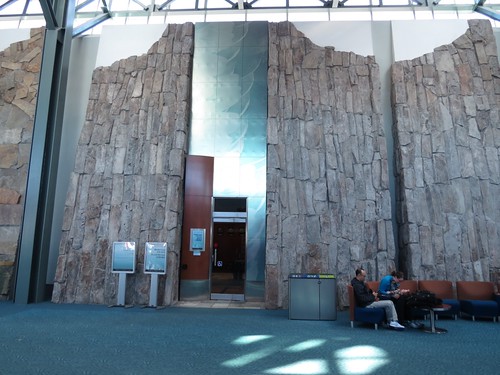
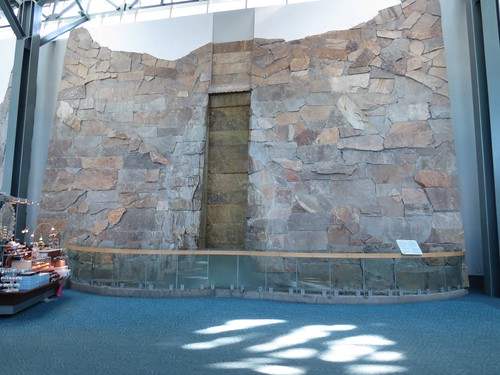
Have you been to the Vancouver Airport?  If you have, you've probably walked past this ginormous feature below.  Have you ever wandered over and read the little sign there about this wall?  Probably not, unless you're 1) bored out of your face (which, it's an airport, you're either bored out of your face or stressed out and running to catch a plane - there is nothing in between in an airport), or 2) a geologist.  And especially when you're both of these things.

Sea to Sky Wall in Vancouver Airport
Centre panel with waterfall.  The rock here is the Garbaldi Golden Granite (actually granodiorite).
I love this feature.  It's two stories high at least and has a lovely waterfall in the middle, which gives the surrounding air a lovely ozone-y smell.  It's as peaceful a place as you're going to find in a busy airport like this one.  And it has rocks, so bonus!

So as an extremely bored geo, I thought I'd share it with you.

Sea to Sky Wall in Vancouver Airport
One of the two side panels (and the entrance to the Maple Leaf Lounge).  The rock here is the columns of Rhyolite.
I'm not going to upload a photo of the write up since there was too much glare, so I've transcribed it below:

THE SEA-TO-SKY WALL

Shaped by the earth's heaving crust, fiery volanoes, and colliding terranes, the rocks and mountains of British Columbia tell a story over 200 million years old.  

Much of our mountainous west coast is formed of granite, an igneous rock.  Here, molten magma crystallized far below the earth's surface to become one of the largest masses of granite in the world.  North of Vancouver, Mount Garibaldi rose through the surrounding ice in a series of volcanic eruptions about 20,000 years ago, its granitic cone created by the cooling lava.

Displayed on this wall are two local varieties of igneous rock.  The ways in which they evolved resulted in their different grain sizes, crystal shapes, mineral content, and colours.  Both types of rock were quarried by Garbaldi Granite from unique deposits in the Squamish Valley, located near the Sea-to-Sky highway between Vancouver and Whistler.

Centre panel with waterfall:
Garbaldi Golden Granite is a coarse-grained rock known as granodiorite.  Its large crystals of feldspar and quartz were created during the slow cooling of magma within the earth.  The unusual golden colour of this granite developed over thousands of years, as iron-rich soils leached through its crevices.  The rock is quarried without explosives; a wedging system is used instead to avoid cracks and damage.

Other [two] panels:
Rhyolite is similar in composition to granite, although it is more finely textured.  It occurs naturally in 6-to-8 sided columns - the result of lava cooling rapidly at the earth's surface after a volcanic explosion.  The columns are easily quarried by machine from their loose deposits.


I have to note, before I continue, that granite and granodiorite are entirely different rocks based on mineral content, so I'm a little annoyed with the description above.  But oh well, granodiorite forms in a similar manner, it's only different chemical compositions of the magma itself that determines the rock type that forms.  LET IT GO HEATHER.

Sea to Sky Wall in Vancouver Airport
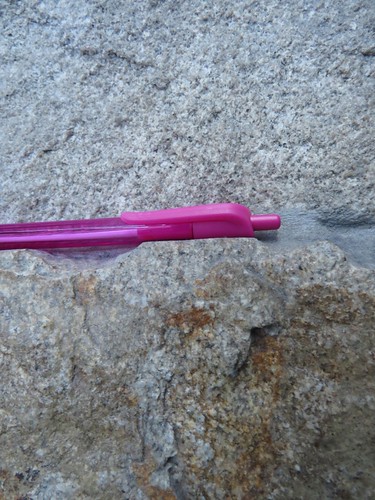
Close up of granodiorite, bright pink pen for scale.
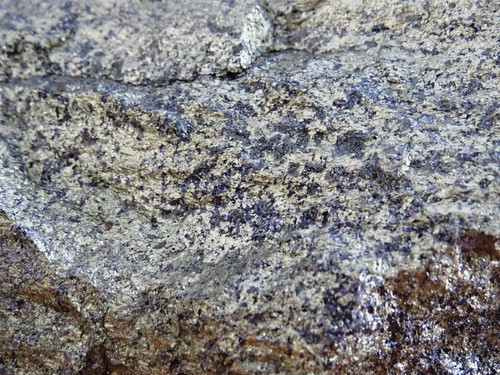
Here's a close up of the granodiorite. It was difficult to photograph, since the yellow colour they noted actually masks to individual crystals.  I found one piece that was cleaner, so you can sort of see the coarse white feldspar, the light-grey quartz, and the smaller-grained, dark coloured mafic minerals (usually dark coloured, denser minerals that are usually the first minerals to crystallize from the cooling magma as they have a higher melting temperature).

Sea to Sky Wall in Vancouver Airport
Rhyolite columns.  Bright pink pen for scale.
Here, you can see the tall, narrow columns they were talking about in the rhyolite wall.  I actually thought that these columns only formed in another rock type - basalt.  We have columnar basalt in Whitehorse - maybe I'll write up a post about them this summer.

Sea to Sky Wall in Vancouver Airport
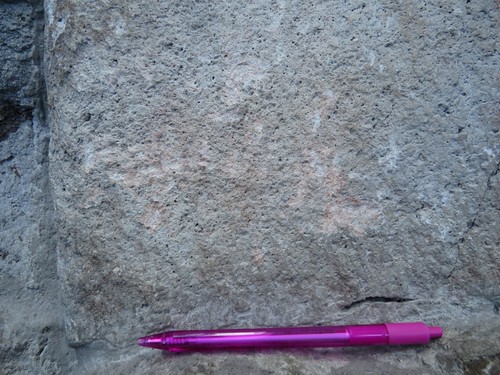
Close up of the rhyolite.  Bright pink pen for scale (you sick of me stating the obvious yet?  Sorry but too bad, I'm stoked that I actually remembered to include a scale in my rock photos!)
Here's a close up of the rhyolite.  I know it looks similar to the granodiorite, but it's actually very fine-grained so you can't really see any individual crystals, and those dark bits that look like the mafic minerals in the granodiorite?  Not actually minerals.  They're gas bubbles called vesicles, that formed when the magma got closer to surface and the gas within the magma that was dissolved at depth, started to separate out and form bubbles.  Pretty cool, eh?

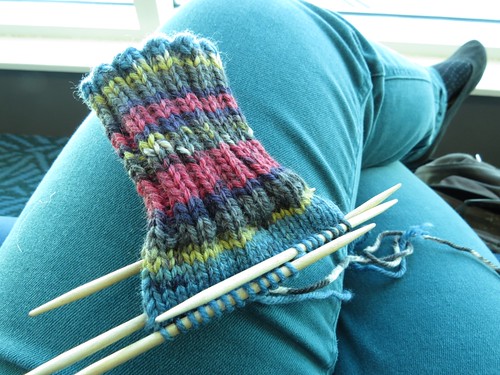
Travelling sock wip
Cruising along on my sock!
And for something different, this is my travel project.  I'm making myself a pair of socks!  I wonder if I can finish this one before i get to Winnipeg?  I only have another 10 hours of travel...

Vancouver!
My view of Vancouver while writing this post.  You're very pretty, Vancouver.  Someday I'll visit more of you than your airport.

Wednesday, March 11, 2015

Slick Rocks or Slicks in Rocks?

Answer: BOTH!

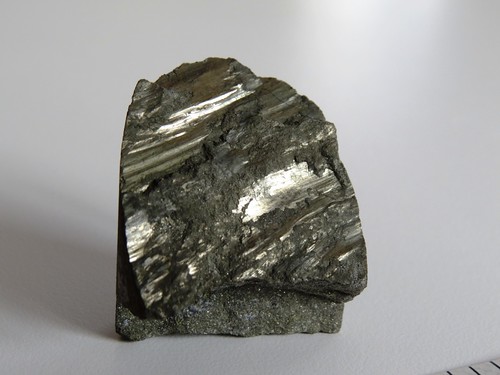
Slicks in Massive Sulphide
Today's rock also comes from Wolverine Mine in the Yukon.  This rock is a piece of drill core that I collected it in the fall of 2013 when I was part of an underground exploration and production drill program.  Normally you wouldn't be allowed to take *coughstealcouch* drill core, but underground production drilling is different than surface exploration, and you don't need to save and store all of the core drilled.

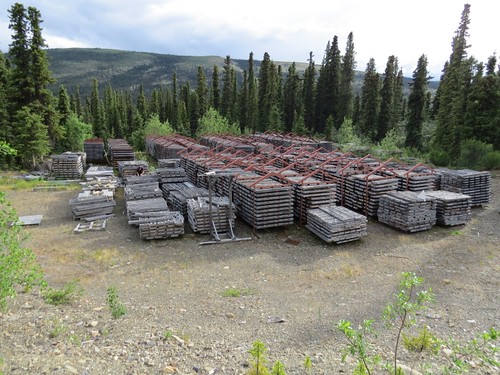
Drill Core Graveyard
This is the surface exploration drill core from the mines' exploration program.  There's not as much core as there should've been, but lets not get into that...
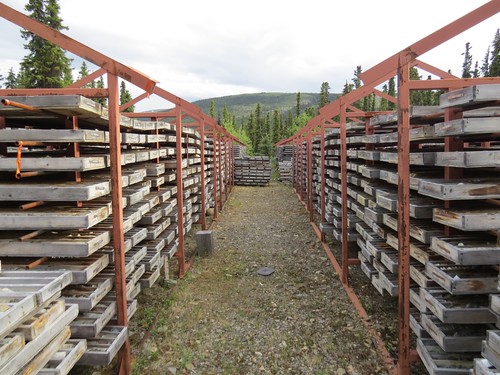
Drill Core Graveyard
Each of those core boxes contain about 3-4 m of core.
Which is a relief because drill core graveyards like the one above is what you get suck with.


Anywho, when I saw the slickensides and slickenlines on this sample, I happily took my rock hammer to the core and pocketed the sample right away.  I actually had both sides of the fault, but I gave the other half of it to a geologist friend.  What are we looking at and what the heck are slickensides/slickenlines, you ask?  Well let me tell ya!

I'm sure you've heard of faults - they often come up when you hear of earthquakes, and there's the ginormous one in California, the San Andreas Fault.  Faults are fractures or cracks in the rock where displacement (or movement) occurs, allowing two blocks of rock to slide against each other. The energy released when rocks shift can cause earthquakes if the fault or the displacement is big enough.

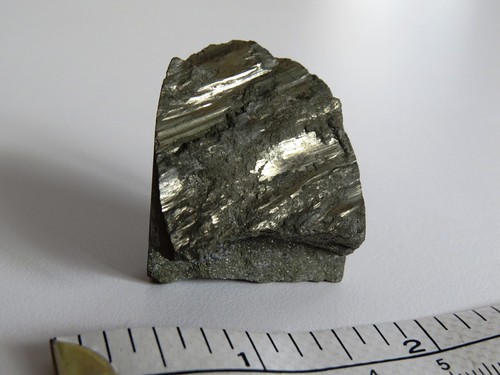
Slicks in Massive Sulphide
This sliding motion can do a lot of really cool things to the surrounding rocks.  If the fault breaks the rock fairly cleanly (as opposed to smearing it if the rock is more "plastic" or soft and malleable, which can happen at depth), each side of the fault can become polished as the rock moves against each other.  If the rock in question contains a lot of metal, such as in a massive sulphide deposit, this polish can have a mirror like effect!

This polished surface is called a slickenside.  As in, the side of the fault has been polished slick. 

Slicks in Massive Sulphide
Now, it's rare that you'll find slickensides without slickenlines.  Slickenlines are the grooves (or lines) scratched into the slickenside surface as the rocks move together.  But because you often don't find one without the other, we usually just shorten the entire feature as 'slicks'.

Slickenlines showing the direction of displacement. (source)

The really cool part of slicklines is that the lines point in the direction of general movement, and other features can actually tell you which side moved what way.  This is more difficult to identify in drill core unless you put a lot more work during drilling, but it can give you some idea.  Where this is more useful is in outcrops at the surface, where you can get proper azimuth and dip measurements, and is regularly used when discovered to identify fault movement.  I saw slicks underground all the time at Wolverine Mine, and always noted the direction of movement on my maps.

Slicks in Massive Sulphide
And just for some context, here's what the rock looked like where the slicks occurred.  As I mentioned somewhere above, the slicks are the massive sulphide deposit, which mostly contained a lot of fine pyrite ("fools gold", an iron-rich metallic mineral with chemical composition FeS2), a little bit of chalcopyrite (the more yellowy copper- and iron-rich mineral, CuFeS2), and some white calcite (CaCO3).

Pretty slick, eh?

:D

Any questions about faults, slicks, or anything else I blathered on about in this post?  Is there any type of rock or geological feature you'd like to learn more about?  I'm happy to take rock requests!

Monday, February 09, 2015

Life at the Mine (Pic Heavy!)

Well guys, I've been putting off tackling this post, partially because it's a bit of a slog trying to wittle down my photos to a reasonably sized post (and also try to track down photos from underground - I wasn't really successful at either), and partially because it's bittersweet.  I'll get to that latter part later.  I'm going to explain how my job works, but I'll also be sprinkling in a bunch of photos from around the mine site, because I have a lot of them!
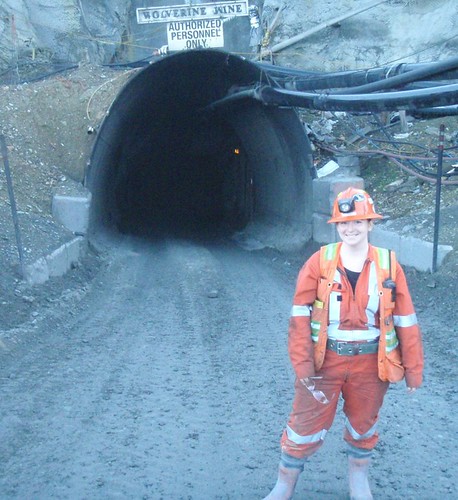
In front of the mine portal
Here I am, in front of the portal leading underground.  This is, honestly, the only picture I have of myself in my gear and anywhere near underground.
So you've been asking for details about life at an operating mine, and here it is.

I'm a production geologist at an underground mine in the Yukon.  Basically what that boils down to is that I go underground, get in everyones way, look for shiny rocks, draw pictures, and tell everyone where to go. 

Well okay, there's a bit more to it.

The Mill - where the ore we haul up from underground is processed and our economical metals are extracted (copper, zinc, lead, silver, and a bit of gold).  Awesome storm over the lake in the background.
We use a cut-and-fill mining method, where we excavate long tunnels or 'drifts' following the ore (the rock that contains the economical metal-bearing minerals) by blasting out the rock in 3.5 m long rounds, then fill it back up once the drift is done with a combination of waste material (non-economical rock) and paste (a goo made from cement and tailings [the left-over material after we mill the ore]).  Because the ore body is tilted at about a 40 degree angle, we will then mine another level (aka 'lift') above and to the side of the previous, like a series of steps.

Are you still with me?

Here's a jumbo, drilling off a round at our mine.  If you look closely, you can see the ore (lighter brown) dipping from upper left to lower right across the 'face' (the leading edge of the drift). 
We drill off these 3.5 m rounds using a Jumbo Drill.  The geologist job is to go in to see every single round that was blasted, map the ore in the whole round, especially the face and back (face = leading edge of the drift, back = the ceiling of the round, and walls or ribs = the walls on either side of the tunnel).  Once it's mapped and I've sampled the ore, we tell the jumbo operators what direction to turn.  The ore isn't perfect - it pinches and swells, meanders about, and sometimes a fault will cut it off or send it off in another direction.  It's our job to 'read' the rock and anticipate any upcoming turns in the ore, then tell the drillers how to follow it.

Our drillers are fantastic guys who have more experience underground than I have out of diapers, so one learns to tell them where to go very respectfully!  And honestly, I've learned more from those guys than I ever did out of a textbook.

The view as you exist the portal.  This is a wonderful site after walking up the I-don't-even-want-to-know-how-many kilometre hike up from the bottom of the mine.
Once I'd been around to all of the blasted rounds that day, me and the Geotech Engineer (the guy in charge of ground support - I'll explain that more soon) will go to surface, talk to the miners shift supervisor, drop off samples at the lab, and clean up.  Because I'm a geologist, so of course I've got to play with the rock and climb equipment and get sprayed by water and generally find any way possible to get filthy, a shower is definitely called for - yes, even at 10 in the morning when we get back up.

This is a clean day - you can see the pasty skin on my hands and my face is practically spotless!
Did I mention that our day starts at about 5:30?  Yeah, it sucks as badly as you think it does, especially for this night-owl.

We can get a lot of snow...
Anyways, once up in the office, I make up good copies of all of my maps, update all of our digital maps and input data into various programs, and assist with mine planning.  I also plan for the following day, trying to anticipate any surprises or upcoming turns in the ore.  And then go bug anyone available - my favourites is our Environmental Coordinator (who is awesome and hilarious and gets so exasperated by all my geeky enviro-geochem questions) and our Geotech Engineer, because I live to sass that guy.

My days are very predictable and unchanging, but the details are interesting.

Source
Underground though, our miners are as busy as ants.  We usually blast all of the rounds drilled off and loaded with explosives at the end of day shift.  Every round that gets blasted, needs to be first mucked out with a scoop.  That means that the equipment shown above goes in and 'scoops' out the blasted rock and takes it to a big underground haul truck, which generally hauls the rock to surface (unless it's being stored underground somewhere).

Bolter in an active drift. You can see bolt heads and screen up on the walls and back.  Also our Geotech Engineer on the right.  Shiny doofus.
Once all of the rock has been hauled away, the round needs to be supported.  The ground (the surrounding rock) at our mine is bad - like, really bad.  It crumbles away like nothing, and if we don't keep drift sizes as small as possible, or if we go too far into the soft rock above the ore, or if we don't support the round properly, we could wind up with a rockfall, and someone could get hurt, or worse.  So this is a hugely important job and the reason why our Geotech Engineer goes around to all of the active drifts with me - he makes the call about what ground support is needed, and keeps an eye on other areas of the drift in case things are deteriorating.  Then he tells the bolter (the miner who installs bolts and screen on our bolter equipment) what will be needed.

These guys are also fantastic.  They really know their stuff.  And since they're drilling into the rock all around the drift, they usually have a good feel for what types of rock is around us and are immensely helpful by passing on that information to me, which in turns helps me make more informed decisions. 

Once a round is supported, the next round can be drilled off, and thus we complete our little mining cycle!

Sunrise in the winter...after 10 am.
Seriously, we have the best guys at our site - all of them are just fantastic and one big well oiled machine.  They work in a mine with one of the worst ground conditions in Canada (and possibly North America) with minimal staff and some real tempermental equipment.  And they do it with a (generally) possitive attitude and the knowledge and drive to get it done properly and safely.  I've learned so much from them and admire them immensely.

One of the planes that take us back and forth from Whitehorse.
Life at the mine itself is interesting.  I do a two and two rotation, where I work two weeks straight at the mine doing 12 hour days, and then back home for two weeks out.  My Mom always comments about how I only work half of the year, but to be fair, we work 168 hours in that two weeks, the equivalent of full time hours PLUS eight hours overtime a month.

View of the sun rising over the mountain range as we fly out of camp.
Since I live in Whitehorse, my commute back and forth to the mine is easy - just a 45 to 90 minute flight (depending on the plane) to the mine - people coming from Vancouver or Toronto or worse - the Maritimes - have a much further trip and lose some of their time out to travelling.  The flights are lovely though - we usually fly low enough to get a good view of the mountains and early enough that we get to watch the sun rising over them (if it's not summer and the suns already been up for hours by then).

3 of the 6 dorms on the right, the two men's dry and the one tiny women's dry (place to change and shower and 'dry' your gear after being underground) at the top, and offices on the left.  And low cloud layer above - we're usually socked in like this on Thursdays - because of course Thursdays are Flydays.
We live in Atco trailer dorms, eat in a kitchen constructed out of a bunch of Atco trailers attached together, and work in offices made the same way.  I don't seem to have interior shots of any of them - weird.  We all have our own individual rooms with shared bathroom facilities - and yes, there's dedicated women's washrooms.  Our rooms consist of a tiny bed, a desk and chair (which, in my case, are both generally covered in yarn), a shelf with a TV on it, and two closets.  I share my room with my cross-shift - the women who I share my job with and who comes in when I go out for my two weeks.

Sundogs on the airstrip.

Having a good relationship with your cross-shift is key, in my books.  Makes your job so much easier when there's no conflict there.  We're lucky because me and my cross-shift think and do our job very similarly, so things are really consistant between us.  Plus we're friends, so we try to make eachothers rotation as easy as possible.  The only down-side is that despite living and working in the same place, we only ever meet up for a few minutes on the airstrip on Flyday.  :(

View from my office window.

What else.  Well, as I mentioned before, our day starts anywhere between 5:30 and 6:00 am (we get in earlier than normal so we can make the miner's morning meetings), and I'm usually underground by 6:15, and up anywhere between 8:30 and 10:30, depending on the day.  The rest of the day is spent in the office.  Meals are provided for us by good cooks - too good sometimes, and we usually have a nice selection of food.  And there's always too many damn desserts available.

You can't see me!
We have gym facilities, as well as a big TV room and phone booths for calling home.  There's also a few trails we're allowed to hike/snowshoe, although those can be closed the moment a bear is seen.  Yes, we see lots of bears up there, and porcupines and moose and caribou and ptarmigans and so much more!

I climbed up to the peak seen above three times.  And half-way up a few more.  It's a haul alright, especially after a 12 hour shift, but it's worth it for the views:

Looking down the valley to the south.  Camp facilities, including all 6 dorms with the kitch in the middle at the middle-right, and tailings pond and airstrip to the left.
Looking up the valley to the north.  Part of the mill facilities on the lower-left with the mine portal and associated supply area in the middle-left, and Wolverine Lake to the upper right.
Why yes, I did haul my knitting up there once!
Snowshoein' up the mountain one fine winter day.
If you haven't picked up on it yet, I really love this job - not only because it's an awesome job, but also because of the people I work with.  We've been through so many ups and downs, that the bs has mostly been cut through and we all - everyone on site - works hard together to pull it off.

I should say, worked hard.  Because unfortunately, the mine has been shut down again, and I'm pretty sure it won't start up once more.  Long-time readers of my blog(s) may remember that I've been laid off from this place twice before?  Well, I have a feeling that third-times the charm.  I'm hopeful that things will come back together and the mine will open again, but I need to be realistic too.  It's sad, but this is the mining industry, and we're in another slump.  You can't get into this industry thinking that you'll be at the same place for decades at a time.  I'm happy and thankful that I got two years working with such a great crew, but I'm sad that it's ended.

Hense the bittersweet comment at the start of all this.

On the airstrip, leaving camp after my very first rotation.  Didn't get a pic of me leaving camp on my very last.  This will have to do.

What am I going to do now?  I don't know, really.  I'm giving myself some time off - unless a good geo job comes up, I'm cutting myself slack in job hunting.  I'm knitting up a storm, thinking of more sewing projects, re-studying geology (watch for posts on the cool stuff), and wanting to spend more time on my skis (both cross-country and downhill) - if this weather ever warms up.  Oh, and hanging out with my cross-shift.  Beyond that?  I don't know - we'll see what comes my way!

The Canadian Flag flying on the ridge above camp.
Do you have any questions about the mine operations?  I know I've thrown a lot at you here in an unending babble, but there's even more I've skipped over.  I'm happy to answer any question I can about the mining process and life at the mine.
Thursday, October 23, 2014

Rock Post: Bornite

Bornite Samples
So as you can probably tell from my blog title, I like rocks.  I'd blame on the fact that I'm a geologist, but I've been smashing rocks to find shinies since I was 4 years old (and then going door-to-door to sell them), so really, becoming a geologist was inevitable. 


Just because I work as a geologist, doesn't mean I get immersed in the science of it very often (which is why I want to start sharing more on this blog - use it or you'll lose it, and all that).  My job is pretty routine, and basically boils down to identifying shiny rock (ore) from dull rock (waste), and following their trend to get the most shiny.  And drawing lots of maps, which sometimes involves colouring with pencil crayons.

Seriously, I have the best job ever.

Bornite Samples
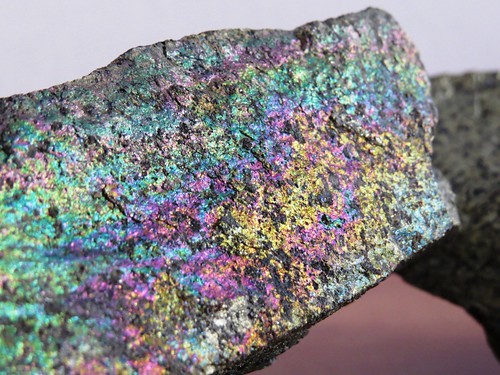
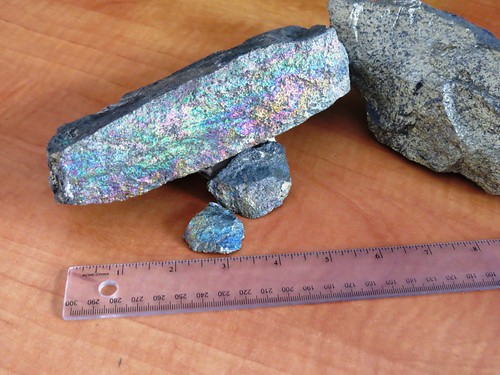
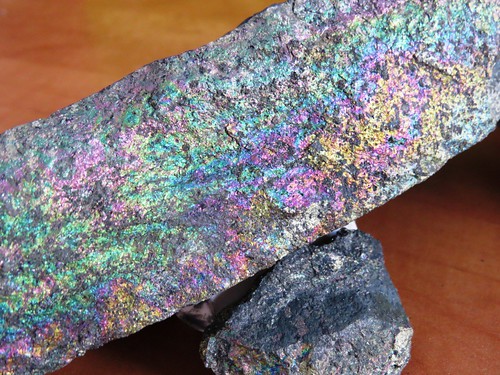
Despite the routine, we occasionally find some really pretty specimens.  Like the bornite sample above!


Bornite is a copper sulphide mineral and one of the sources of copper metal in our mine (we mine zinc, silver, copper, lead, and a bit of gold).  For those curious about these things (I AM!  Haha I'm such a geochemistry geek), the chemical formula for bornite is Cu5FeS4, and the mineral generally contains 63% copper.  It's had a lot of different names over the years, most of which can be translated to some variation of "colourful copper ore", but was finally settled on as bornite in 1845 after Ignaz von Born (1742-1791), an Austrian mineralogist and invertebrate zoologist*.

Bornite Samples
Today, it's commonly called "peacock ore" because of the stunning colours that bloom across the surface as it oxidizes (aka tarnishes - like all of your Grandma's silver you were forced to clean as a child).  This mineral can oxidize very quickly - these samples oxidized in the 12 hours between the rock was blasted and my visit underground.  Granted, the was so much water pouring out of the surrounding rock that I'm surprised we didn't need a boat, so that probably helped a lot.  (Water, especially oxygen-rich water, can cause more rapid oxidation than just exposure to air.)

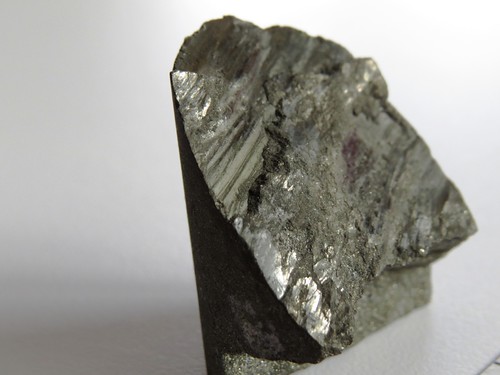
A less exciting (but still shiny!) version can be seen below.  Some of the darker blebs in the rock is quartz, a bit of sphalerite (our zinc-bearing mineral), and I suspect there's a bit of pyrrhotite in there somewhere as well.  I know there's a ton of pyrite (aka fool's gold) mixed in as well, but I have a tough time distinguishing them in this sample here.  Though if I dunked this sample in water for a week, the pyrite would turn rusty and the bornite colourful, which would identify them both - but then I'd be stuck with an ugly rusty rock with a bit of colours peeping out. 

Bornite Samples
We don't actually see much bornite at our mine, or at least, we don't often get a chance to identify it because it can resemble some of the other minerals we find underground, and we don't spend much time studying rocks in production mining.  That's for exploration projects.  Which is why we were so excited when one of our headings was chock full of it.  As you can see, it can be really pretty when oxidized!

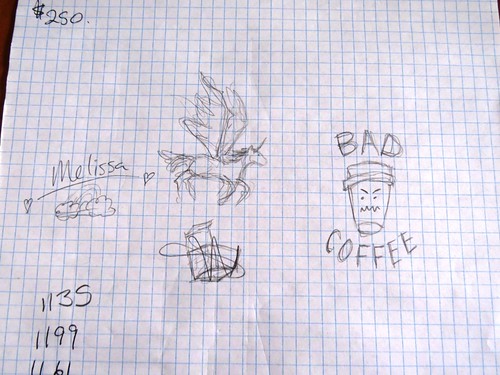
 And just for shits and giggles, here's some of my phone doodles that I particularly liked.  One was drawn while drinking some horrendous coffee, and the others were just girly-ness while surrounded in boys.  I'm damn proud of that unicorn, myself!

Doodles


* http://webmineral.com/data/Bornite.shtml#.VElwe7HIR18